-
 Gold Ore Concentrators
Comprehensive Utilization Processes of Tailings from Gold Ore Concentrators
Gold tailings are solid wastes generated after gold ore undergoes mineral separation processing. If not handled scientifically and rationally, they will not only occupy large quantities of land resources but also cause certain environmental pollution. With continuous changes in the international gold market, China’s gold industry is facing unprecedented challenges. Therefore, while vigorously advancing mining and mineral separation technologies, emphasis should also be placed on strengthening the comprehensive utilization processes of tailings from gold ore concentrators.
1、Classification Treatment Process:This process involves processing selected ore samples via a spiral chute to separate them into coarse sand, middlings, and fine mud, followed by gold extraction from the coarse sand.
2、High-Intensity Magnetic Separation Process for Iron Removal:This process is designed to reduce the iron content in ore and enhance the purity of gold ore. When applied to tailings treatment, it aims to remove iron elements from ores that have been processed by spiral chutes, enabling the tailings to meet the basic requirements for ceramic production.
3、Desulfurization Process:Even after classification treatment and high-intensity magnetic iron removal, some sulfur impurities still remain in mine tailings. Pyrite is the mineral with the highest sulfur content and can be completely removed during the reverse flotation process following high-intensity magnetic iron separation. However, adding only xanthate cannot eliminate all sulfur elements from the remaining ore, making desulfurization treatment necessary.
-
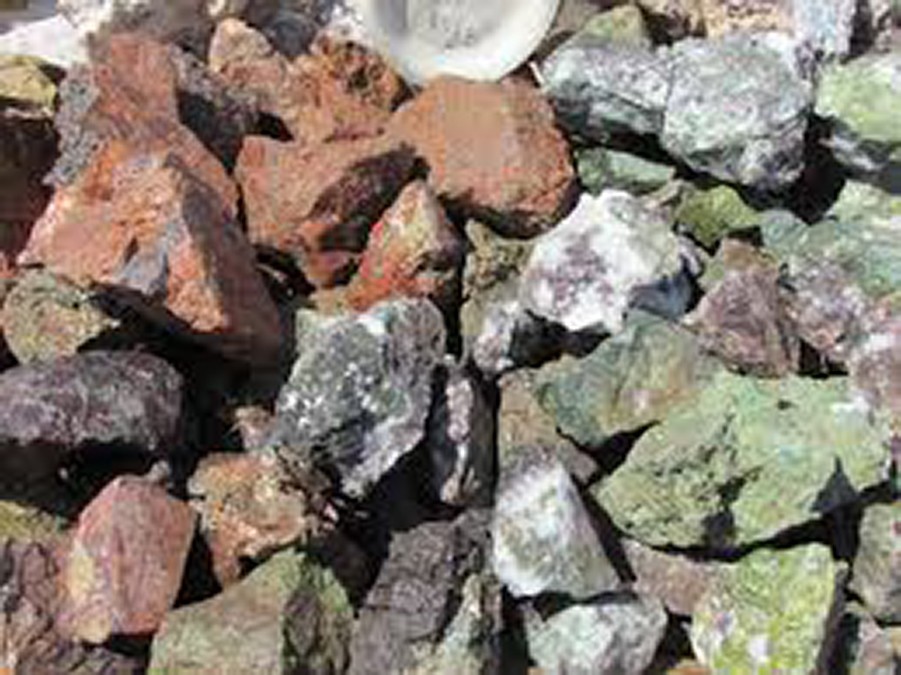 Refractory and Leaching-Resistant Ores
This copper ore treatment process is designed for refractory and leaching-resistant copper ores, and it consists of three core procedures: leaching, solvent extraction, and electrowinning.
The specific process flow is as follows: Crushed ore is charged into the leaching tank, and the leaching solution is pumped into the same tank. After one complete leaching cycle, the leaching solution is discharged into a low-level storage tank, filtered through a filtration device, and then pumped into a high-level storage tank.
The leaching solution in the high-level storage tank flows by gravity into the extraction-stripping tank. The raffinate is recycled back to the leaching system for reuse; the stripping solution flows into the electrowinning tank; and the electrowinning tail solution is transferred to the tail solution storage tank.
This invention adopts a composite leaching agent, which features strong adaptability and applicability, making it suitable for leaching various types of copper ore resources. Furthermore, using the Lix54-199 alkaline copper extractant for extraction eliminates the need for anti-corrosion treatment of facilities and equipment, reducing initial investment. The leaching agent can be recycled, cutting down on operational costs and avoiding environmental pollution.
-
Pyrite-Containing Copper Sulfide Ore
According to this method, the ore is ground and leached into a sulfuric acid-containing solution via trivalent copper under atmospheric pressure. When copper sulfide is leached, trivalent iron is reduced to divalent iron, which is oxidized back to the trivalent state by oxygen during the leaching process.
Leaching is performed in a closed reactor, where insoluble gases that rise from the solution and accumulate in the upper section of the reactor are recycled back into the suspension composed of solution, solids, and gases. The leaching is carried out under conditions where divalent and trivalent iron are present, and preferably with dissolved copper (acting as a catalyst to facilitate leaching). The conditions are adjusted such that the pyrite in the ore remains substantially undissolved.
-
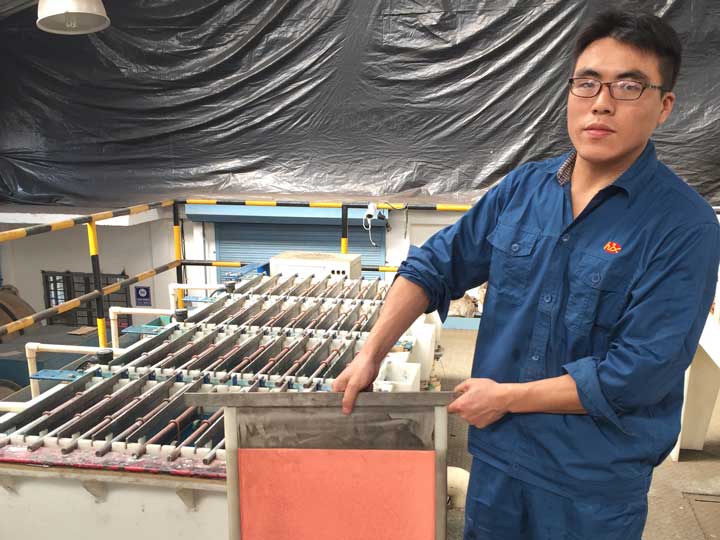 Treating Low-Grade Mixed Copper Ore
Combined Flotation-Acid Leaching Process for Treating Low-Grade Mixed Copper OrThe flotation process comprises three steps. Firstly, a novel high-efficiency collector MA is used as the collector for sulfide copper ore to conduct direct flotation of sulfide copper ore.
Subsequently, oxidized copper ore is recovered through sulfidization flotation and direct flotation respectively: the novel high-efficiency collector MA serves as the collector for sulfidization flotation, while sodium oleate is employed as the collector for direct flotation of oxidized copper ore. The flotation mixed concentrate is centrally subjected to acid leaching treatment, and the filtrate is collected after filtration.
This method improves the copper recovery rate and reduces production costs by integrating mineral processing and metallurgy. Additionally, it is simple and easy to implement.
-
Producing Sponge Copper from Discarded Copper Oxide Ore
This is a method for producing sponge copper from discarded copper oxide ore, applicable to such ore with a copper content of 0.5% or higher.
Crush the discarded copper oxide ore into 2-4 cm gravel, place it in a stainless steel boiler, add water until the gravel is completely submerged, then add dilute sulfuric acid with a concentration of 40%-60% at a dosage of 20-30 kg per ton of gravel. Heat the stainless steel boiler at a temperature not lower than 100℃ for a duration of no less than 8 hours. Remove the gravel from the boiler and discard it, while retaining the reacted solution in the boiler.
Transfer the reacted solution to a reaction tank, add iron filings and stir. When the solution turns pale, drain the wastewater, fish out the iron filings, and the remaining substance in the reaction tank is sponge copper.
This method boasts the advantages of high recovery rate, low cost, high profitability, simple and feasible process, ease of operation, no pollution, and no exhaust gas emission.
-
 Copper from Combined Copper Oxide Ore
Method for Hydrometallurgical Extraction of Copper from Combined Copper Oxide Ore
The method comprises the following steps:
1、Crush and then grind the combined copper oxide ore to obtain ore powder;
2、Pretreat the ore powder with an alkaline solution to obtain a pretreatment solution and pretreatment residue;
3、Perform acid leaching treatment on the pretreatment residue, and obtain a copper-containing acid leaching solution after filtration;
4、Extract copper from the copper-containing acid leaching solution to obtain sponge copper.
The present invention first pretreats the ore powder of combined copper oxide ore with an alkaline solution, then achieves the leaching of copper from the combined copper oxide ore via the acid leaching process, and further recovers to obtain a sponge copper product. The invention exhibits a significant extraction effect on copper in combined copper oxide ores where the occupancy rate of the copper binding phase reaches 40% or more, with the copper leaching rate ranging from 80% to 93.5%.
-
 Leaching Treatment Method for Copper-Bearing Ores
Leaching Treatment Method for Copper-Bearing Ores
The leaching treatment method for copper-bearing ores comprises the following steps:
1、Use ammonium sulfate as the solid-phase reactant, fully mix it with crushed and ground copper-bearing ore, and then roast the mixture;
2、Transfer the product of the above-mentioned solid-phase reaction to hot water, conduct stirring and leaching, and then perform filtration;
3、Carry out separation and purification on the filtrate according to the ore components.
Under atmospheric pressure and low reaction temperature, the above method uses ammonium sulfate as the reactant to undergo a solid-phase reaction with copper and other metals contained in the ore. Copper is then transferred (leached) into the solution via clean water, which facilitates further separation and refining and ultimately yields the target product.
The ammonia released during the ore dissolution reaction and the remaining ammonium sulfate solution after separation of the leaching solution are respectively recovered and recycled, thereby forming a self-circulation of raw and auxiliary materials within the system and minimizing the loss of ammonium sulfate. Compared with conventional treatment methods, the leaching treatment method for copper-bearing ores of the present invention has the advantages of low environmental pollution, low energy consumption, and significantly reduced production costs.
-
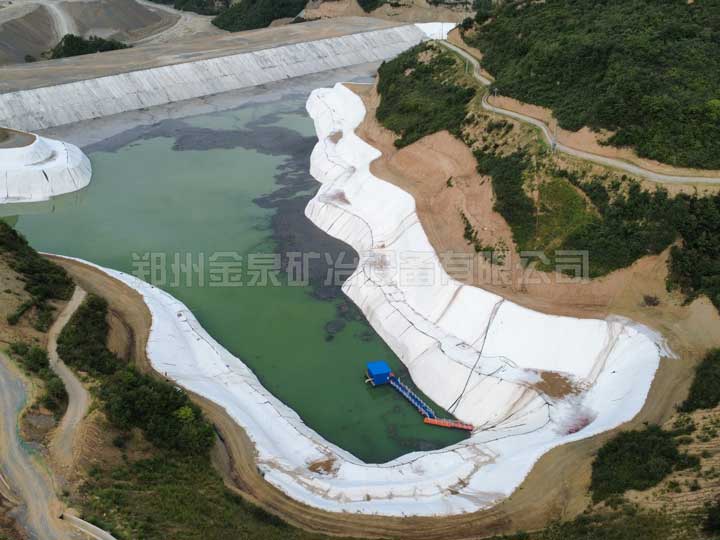 Leaching Method for Oxygen-Sulfur Mixed Copper Ore
A Leaching Method for Oxygen-Sulfur Mixed Copper Ore
A leaching method for oxygen-sulfur mixed copper ore, belonging to the technical field of hydrometallurgy.
The oxygen-sulfur mixed copper ore is first ground; then it is added to an aqueous ammonium carbamate leaching agent containing an oxidant for oxidative leaching, and a copper-rich leachate can be obtained through solid-liquid separation.
This method does not require high-temperature and high-pressure equipment for the reactor; it has the characteristics of low impurity content in the leachate, low loss of leaching agent during the leaching process, easy separation of copper from impurities, low leaching production cost, and little environmental pollution.
-
Recovering Copper from Combined Copper Oxide Ore
The method is as follows:
Crush and grind the combined copper oxide ore, then mix it with water to obtain raw ore pulp;
Subject the raw ore pulp to beneficiation using the process of "low-intensity magnetic separation - gravity separation - high-gradient magnetic separation";
Combine the gravity separation concentrate and high-gradient magnetic separation concentrate obtained from the beneficiation process, filter to get enriched residue, and prepare primary pulp;
Add sodium hydroxide for pretreatment, and obtain pretreatment solution and pretreatment residue after filtration;
Prepare secondary pulp and carry out acid leaching on it to obtain copper-containing acid leaching solution.
the recovery rate of copper is no less than 80%, and sponge copper with a mass purity of not less than 90% can be obtained through further extraction. It has the advantages of high beneficiation index, high product quality, strong operability and simple process flow.