-
 high-purity silver electrolytic production process
High-Efficiency High-Purity Silver Electrolytic Production Process
Using either a Dore metal or crude silver as the anode and silver nitrate (AgNO3) as the electrolyte, employing a high-current-density electrolysis technology, produces silver powder with a purity of 99.99% or higher.
After cleaning the anode, it is directly placed into the anodic electrolytic cell to produce silver powder with a purity of 99.99% or higher.
Waste electrolyte undergoes oxidized silver purification, achieving purified electrolyte standards before recycling for reuse in electrolysis.
-
 mud pressure leaching-kaldor furnace treatment process
copper anode slime mud pressure leaching-Kaldor furnace treatment process
Step-by-step recovery of silver, selenium, and tellurium from copper anode slime leaching solution;
Carlton furnace melting produces lead-bismuth slag, tellurium slag, and dore alloy.
-
 sulfuric acid roasting-converter treatment process
Sulfuric acid roasting-converter treatment process
Cu slag sulfurization roasting: High-temperature sulfurization roasting of selenium with forced cooling to capture selenium.
Acid leaching of copper: Copper solutions are settled with silver and copper precipitated.
Furnace reduction smelting, removal of lead, bismuth, tin, and tellurium, and processing of dore alloy.
-
 recovery method for valuable metals in copper anode slime
Sulfuric roasting-hydrometallurgical process
Cu slag leaching: The first leaching removes copper and arsenic; the second leaching removes bismuth and tin.
Copper separation: Copper solutions are settled with silver and recovered of coltan.
Gold separation: Since the recovery of coltan is canceled, gold is separated from the gold solution in stages along with palladium and platinum.
Silver separation: Sodium sulfide and ammonia (ammonia gas) are used for silver separation. -
 gold mining cyanide leaching process
gold mining cyanide leaching process
Cyanide leaching: The gold is separated from most minerals using cyanide, resulting in a gold-bearing slurry.
Activated carbon adsorption: Activated carbon absorbs gold from the cyanide solution.
Activated carbon desorption: The absorbed gold is removed from the activated carbon.
Electrorefining: The gold-bearing solution undergoes electrorefining to produce refined gold.
Refining: The refined gold goes through wet processing to achieve higher purity.
-
 gold ore reselection process
gold ore reselection process
reselection: Separates gold from most minerals.
parting: The concentrate obtained is refined further through methods like vaporization to increase gold content.
refining: The refined dore goes through wet processing to achieve higher purity.
-
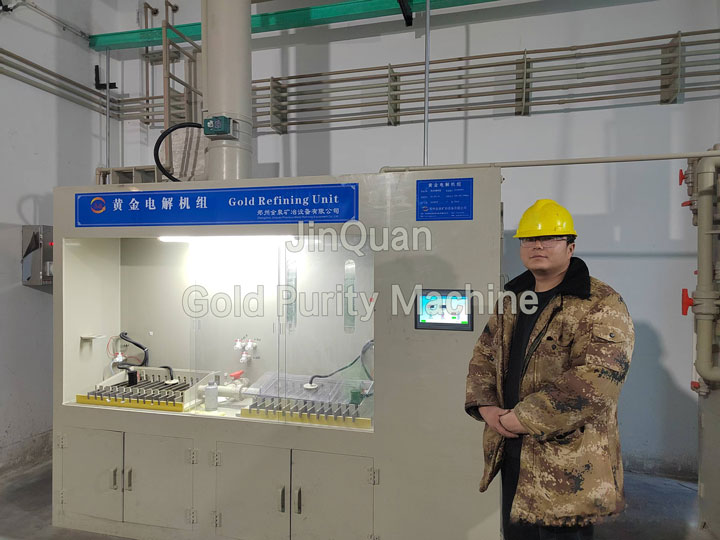 new type gold purity machine explanation
gold purity machine is suitable for refining gold with purity of 90% or higher. The company currently offers standard models such as JQ-JDJ-5, JQ-JDJ-10, JQ-JDJ-20, JQ-JDJ-30, and JQ-JDJ-50, capable of producing up to 50kg of gold per day. Custom orders based on client requirements can be arranged.
The company's ggold purity machine features an integrated, one-piece design, comprising individual electrolytic cells, circulation pumps, isolated power supplies, automatic electrolyte replenishment systems, smoke gas condensing recovery systems, intelligent monitoring systems for electrolyte temperature, voltage, current, and copper plate temperature, as well as data recording systems. The power supply is separately encapsulated and isolated from the plant's acid gases to ensure a long service life.
-
 gold refining electrolysis process
For rough gold with a gold content of less than 95%, initial treatment involves powdering. After powdering, the powdered gold is subjected to acid leaching using nitric acid to remove impurities such as silver and copper. The filtered solution is then processed for silver recovery. The insoluble gold powder undergoes aqua regia dissolution; insoluble residues from this process are subsequently sent for silver recovery. A secondary refining process is applied, where once reduced, 99.99% pure gold is cast into granules or ingots. The refined gold returns to the aqua regia process for further dissolution. After drying, the refined gold is formed into granules and then cast into standard gold ingots.
For raw materials with a gold content of 95% or higher, they can be directly smelted in a medium-frequency furnace, cast into ingots, and then subjected to high-efficiency electrorefining using a gold refining electrolysis system. The refined gold is then cleaned, dried, and finally cast into finished gold ingots.
-
 gold platinum recycling equipment
(1) Dissolve in aqua regia:The residues are placed in a reaction container, and hydrochloric acid (HCl) and nitric acid (HNO3) are added in a 3:1 ratio by mass. The mixture is heated to a temperature between 60°C and 80°C using steam, allowing gold and platinum to dissolve in the solution. After the reaction is complete, the solution is filtered and washed, with the filtrate being sent for platinum extraction.
(2) Based on the differences in the reaction processes of platinum and gold, a separation is performed:Ammonium chloride (NH4Cl) is added to the filtered solution to precipitate platinum, while gold does not form a precipitate at this stage. The solution is then filtered again, and the resulting ammonioplatinum chloride is calcined to produce crude platinum, which contains gold in a high-temperature solution that is then sent for gold reduction.