
The main components of three-way catalysts are as follows: alumina (Al₂O₃) accounts for over 98%, with a palladium (Pd) content of 3000–10000 g/t, platinum (Pt) content of 150–10000 g/t, and rhodium (Rh) content of 150–600 g/t.
The process proceeds as follows: the three-way catalyst is first ball-milled into powder, fed into a reaction vessel, and leached via the aqueous chlorination method in a hydrochloric acid medium; the obtained leachate is then treated via the sodium nitrite complexation process.
This process has multiple drawbacks: it requires secondary leaching, and an excessive volume of leachate will impair the recovery efficiency of precious metals. The leaching residue suffers from incomplete leaching, making it economically unviable to recover valuable components from the residue. The overall process is lengthy and cumbersome: the sodium nitrite complexation step requires multiple cycles to separate platinum, palladium and rhodium, leading to high labor intensity, high reagent costs, and large volumes of waste gas and wastewater. During the hydrolysis of base metals, precious metals are easily entrained in the hydrolysis products. During the separation of Pt, Pd and Rh, the obtained Pt and Pd fractions are often entrained with Rh, while the Rh product contains residual Pt and Pd. The process is difficult to regulate and poses high operational difficulty.
Although this method can directly recover and separate Pt, Pd and Rh, it suffers from low recovery rates, high costs, and a heavy workload for waste gas and wastewater treatment, which is not conducive to environmental protection.
 +8613303827570
-
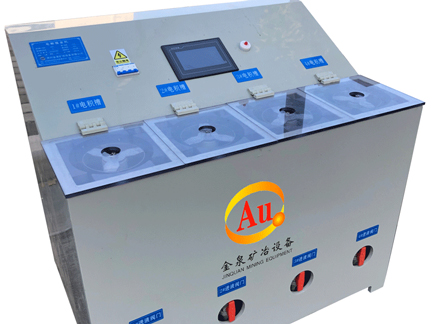 gold recovery equipmentgold recovery equipment
Details of gold recovery equipment
1. Function introduction: The electrolytic gold extraction machine is a technology for wet refining and purification of metals. It can selectively electrolyze valuable metals and is especially suitable for the selective electrolysis (electrolysis) of low-content solutions and solutions with complex components in the metallurgical industry. (accumulation) separation and purification, as well as the recovery of heavy metal ions in wastewater.
2. Technical advantages of gold ecovery equipment:
1)It has the ability to process low-concentration metal solutions, and has higher production efficiency than traditional electrolysis technology to enrich valuable metals in a wider range, from a few tenths of a gram/liter to a few hundred grams/liter of metal concentration for electrolytic production and metal The ability to separate. In particular, it has unparalleled technical advantages in copper-nickel separation and copper-silver separation;
2) It has stronger adaptability to pollutants in the solution and can extract high-purity metals from solutions containing impurities;
3)It has the ability to extract a variety of metals and has the ability to selectively electrolyze metals, and can produce different forms of cathode products (sheets or metal powders) according to the concentration of the solution;
4) The equipment is modular and easy to operate.
-
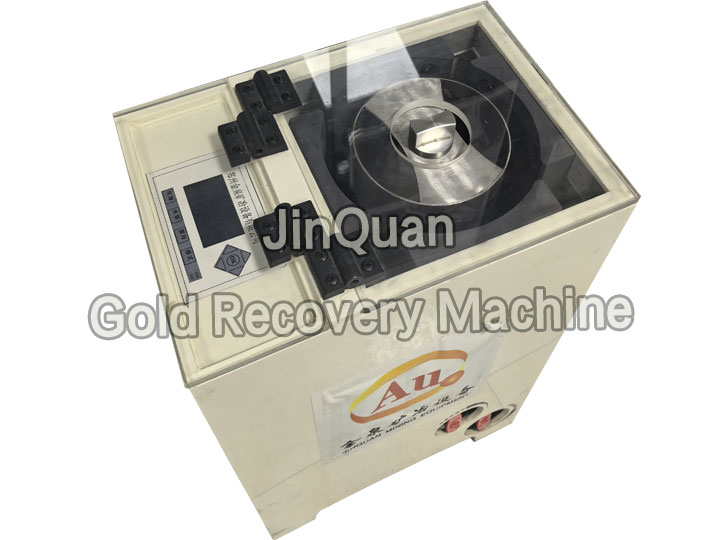 gold recovery machinesilver/gold recovery machine,silver/gold refining equipment,silver/gold refining equipment
Instruction Of Gold Recovery Machine:
The new version gold recovery machine an intelligent touch screen, low-voltage extraction technology, supports fully automated intelligent operation, and offers automatic/manual mode.
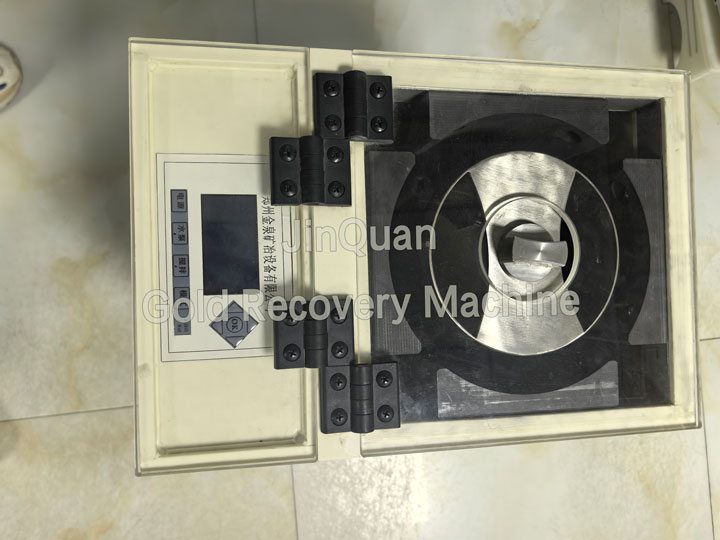
The JQ series uses electrolysis to adsorb gold, silver, copper, and other precious metal ions from solutions onto the cathode. Once a certain weight is adsorbed, the precious metal sheets (gold, silver, copper, etc.) are stripped from the cathode. This equipment enables safe and efficient refining and recovery of various solutions containing gold, silver, or copper, ultimately converting the ions in the solution into pure precious metal form.
Product Advantages:
1、High-efficiency recovery of gold, silver, copper, and other valuable metals;
2、Precious metal purity ≥ 99%, with an ion recovery rate ≥ 99%;
3、Low-voltage extraction, highly efficient, and odor-free.
Model Specifications:
Model
JQ-DJC-L3
Product Name
Gold Recovery Machine
Dimensions
43 x 29 x 58 cm
Rated Voltage
220 V
Power
120 w/h
Weight
45 kg
Capacity
18 L~oo
-
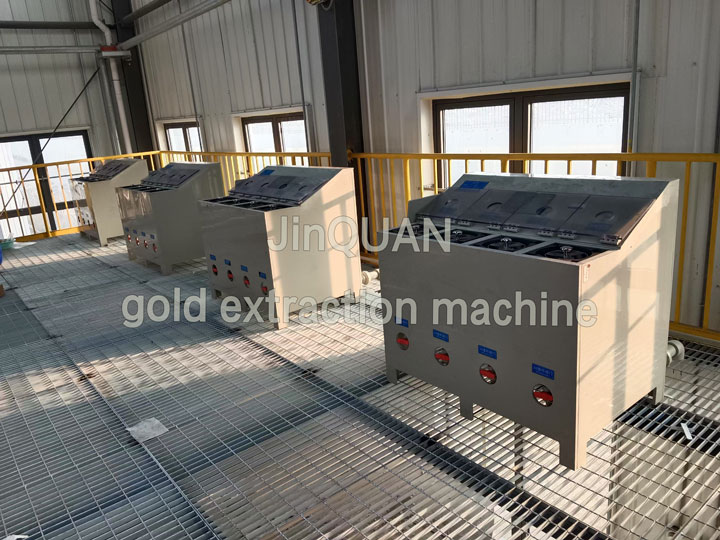 gold extraction machinegold extraction machine,gold recovery equipment
Product Introduction of Gold Extraction Machine:
Swirl electrowinning is a wet metallurgical technology used for the selective electrowinning and extraction of gold. It is particularly suitable for the selective electrolytic separation and purification of valuable metals from low-concentration or complex-composition solutions in the metallurgical industry, as well as for the recovery of gold from wastewater.
Advantages of Gold Extraction Machine:
1)、Capable of processing low-concentration metal solutions with higher production efficiency compared to traditional electrolytic technologies. It can enrich valuable metals across a wide range of concentrations, from fractions of a gram per liter to hundreds of grams per liter, especially excelling in copper-nickel and copper-silver separation.
2)、Strong adaptability to pollutants in solutions, enabling the extraction of high-purity gold from impure solutions.
3)、Capable of extracting multiple metals with selective electrolysis, and able to produce cathode products in different forms (plates or metal powders) depending on solution concentration.
4)、Modular equipment design with simple operation.
Model parameters of gold extraction machine
Product model
Product Name
Dimensions(mm)
Rated Voltage
Power
Weight(kg)
JQ-DJC-L1
gold extraction machine
450*300*600
220V
300w/h
45kg
JQ-DJC-L3
gold extraction machine
900*1010*800
380V
1500w/h
125kg
JQ-DJC-L4
gold extraction machine
1220*1010*800
380V
2.5kw/h
150kg
JQ-DJC-L5
gold extraction machine
1520*1010*800
380V
3kw/h
180kg
Current: Single tank designed for 100A, voltage 5V.
Each small tank can process approximately 200L of solution. Single or multiple tanks can be selected based on production requirements, with processing speed varying according to concentration.Result of Gold Extraction Machine: